
12.11.2026
A wave of the baton or a voice from the patrol car's loudspeaker — and the first thought is always the same: "what for?". In fact the law leaves no room for guesswork here. The list of grounds is closed, and a police officer may stop a car only in clearly defined situations. Below we look at which reasons for stopping a vehicle are lawful, what the officer must explain to you, which documents they may check and what to do if the stop looks unjustified.
Article 35 of the Law on the National Police: 11 grounds for a stop
All lawful grounds are gathered in a single provision. Here they are, translated from legal language into plain words.
The driver has broken traffic rules. The most common reason: speeding, running a red light, an unfastened seat belt, using a phone at the wheel.
Obvious signs of a technical fault. Things visible or audible from outside: headlights that do not work, the car pulling to one side, smoke from under the bonnet, damaged glass.
Information about involvement in an offence. If the police have data linking the driver or passengers to a road accident or to a criminal or administrative offence — or indicating that the vehicle or its cargo may be the object or the instrument of such an offence.
The vehicle is on the wanted list. This check runs automatically, by registration plate.
The driver or passengers need to be questioned. If they were, or could have been, witnesses to an accident or an offence.
Assistance is required. A driver may be asked to help other road users or the police, or to act as a witness while a report or accident paperwork is drawn up.
Traffic is restricted or banned by a decision of an authority. A closed section of road, for example.
The cargo is secured dangerously. If the way it is fastened creates a risk for others on the road.
Misuse of special signals. This concerns the light and sound devices that only certain services are entitled to use.
A vehicle on foreign registration. A stop is possible in order to check whether such a vehicle has been handed over to people who did not bring it into Ukraine or did not place it under the transit procedure.
Information about an escaped prisoner of war. This ground was added in 2022: if there is information that the driver or a passenger has left a place of detention for prisoners of war without authorisation.
Separately, the law lists cases where an officer is not merely entitled but obliged to stop a car — these concern breaches of customs rules regarding vehicles on foreign registration. Nothing else belongs on the list: if the reason given is not there, the stop has no lawful basis.
How the officer must explain the stop
The wording of the law is unambiguous: the officer must inform the driver of the specific reason for the stop, with a detailed description of the ground. Saying "document check" or "special operation" is not enough — they have to name the particular point and explain what exactly prompted it.
The officer also introduces themselves first: they state their position, rank and surname and, on request, present their service ID so that you can examine it. If all you hear instead is a general phrase with no explanation, you are entitled to politely ask again and request the ground.
What the driver should do after the signal to stop
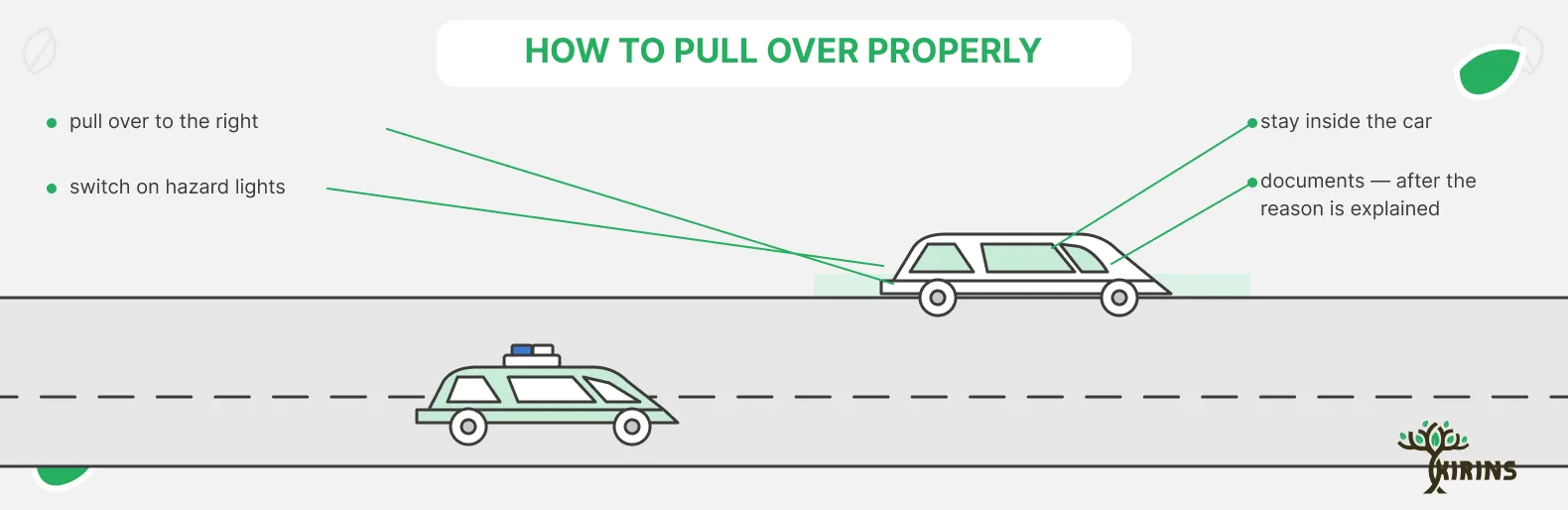
Everything starts with safety. Switch on the right indicator, brake gently and pull over to the edge of the carriageway — not in the middle of a lane and not on a bend. Turn on the hazard lights, and in the dark switch on the interior light as well.
You are not obliged to get out of the car: as a rule the conversation takes place through an open window. Avoid sudden movements, keep your hands visible, and take out your documents only after the officer has introduced themselves and named the ground. You may record the conversation on video — this is lawful, because an officer on duty is acting publicly.
Which documents may be checked
It is worth understanding the logic: checking documents is something that follows a lawful stop, not a ground for stopping a car in itself. But where a ground exists, the officer may check the standard set: the driving licence, the vehicle registration document and a valid compulsory OSAGO.
Insurance comes with a nuance that is easy to forget. There is no need to carry a paper form — policies have long been electronic, and the officer can see the data in the MTIBU database. The contract itself, however, must be valid: driving without one carries a fine, and there is usually nobody to remind you. That is why it is worth renewing your OSAGO insurance in advance, rather than waiting for someone else to notice the expiry date.
What to do if the reason seems unlawful
Start with the main thing — establish the ground. Ask directly which point of Article 35 the officer is applying. Often that settles the matter: the wording becomes more precise and it turns out the reason is perfectly concrete.
If there is no explanation, or it matches none of the grounds, a simple rule applies: record, but do not obstruct. Switch on the video, note the time, the place, the patrol car number, the officer's surname and rank. Refusing to comply with a lawful demand is a separate offence, so arguing at the roadside is pointless — your arguments will work later.
From there you have several options. You can add your remarks to the report before signing it; there is a space for that. You can complain to the head of the unit or to the Internal Security Department of the National Police, or call 102 or the 0 800 500 202 line. And a decision imposing a fine can be challenged in court: if there were no grounds for the stop, that becomes an argument in your favour.
How to be ready for a roadside check
The calmest conversation with a patrol officer is the one you are prepared for. Check that your driving licence and registration document are with you, that the insurance contract has not expired and that the exterior lights work. It is precisely these small things that most often turn an ordinary stop into a report.
It also helps to keep your insurer's number in your phone and the battery charged — both for recording and for calling in case of an accident. Then any roadside stop stays what it should be: a formality that takes a few minutes.