
13.11.2026
Before a trip abroad, drivers keep asking the same question: is a technical inspection required to leave the country, and where do you get one. The answer is shorter than it seems — for a private passenger car with Ukrainian registration no such document is issued at all. There are, however, destinations where proof of technical condition is still requested. Below we look at who actually needs an inspection, what the international certificate is and what is really checked at the border.
Who needs an inspection before driving abroad
Let us start with the main point. Article 35 of the Law of Ukraine "On Road Traffic" exempts passenger cars owned by private individuals from compulsory technical control, regardless of the year of manufacture. In other words, there is simply nowhere to obtain such a document for an ordinary family saloon or crossover.
Compulsory technical control remains in place for other categories, with different intervals:
passenger cars used for commercial carriage and goods vehicles up to 3.5 tonnes older than two years — every two years;
goods vehicles over 3.5 tonnes and taxis — annually;
buses and vehicles carrying dangerous goods — twice a year.
That is why most articles about "inspection for driving abroad" are in fact written for hauliers: for them technical control comes bundled with permits, a tachograph and weight limits, and border checks are far stricter than for a private car.
What the international technical inspection certificate is
The international certificate stems from the Agreement concerning the adoption of uniform conditions for periodical technical inspections of wheeled vehicles, signed in Vienna on 13 November 1997. The agreement entered into force in 2001, and Ukraine joined it in 2007.
Its nature matters: it is an agreement on mutual recognition of inspections, not on a border obligation. It tells member states "recognise an inspection carried out in another member state", not "demand a certificate on entry". That is why the certificate is not a universal pass at every crossing.
Four Rules are annexed to the agreement, covering different categories: No. 1 — vehicles over 3,500 kg, No. 2 — periodic roadworthiness testing, No. 3 — gas-powered vehicles, No. 4 — electric and hybrid vehicles. A passenger car falls within the scope mainly through the last two. So the common claim that the certificate covers every passenger car is not quite accurate — and neither is the opposite one, that it exists only for trucks.
Technical requirements abroad
Periodic testing in the EU is governed by Directive 2014/45/EU, which applies to vehicles registered in member states. A car with Ukrainian registration falls outside it, so there is no "European inspection" for a Ukrainian driver to pass — no such document exists for our vehicles.
This does not mean the condition of your car is of no interest to anyone. Police in the EU may stop a vehicle and assess it on the spot: lights, brakes, tyres, leaks, cracks in the windscreen. No formal certificate is requested for that — they look at the car itself.
Requirements of individual countries, however, differ and are worth checking separately:
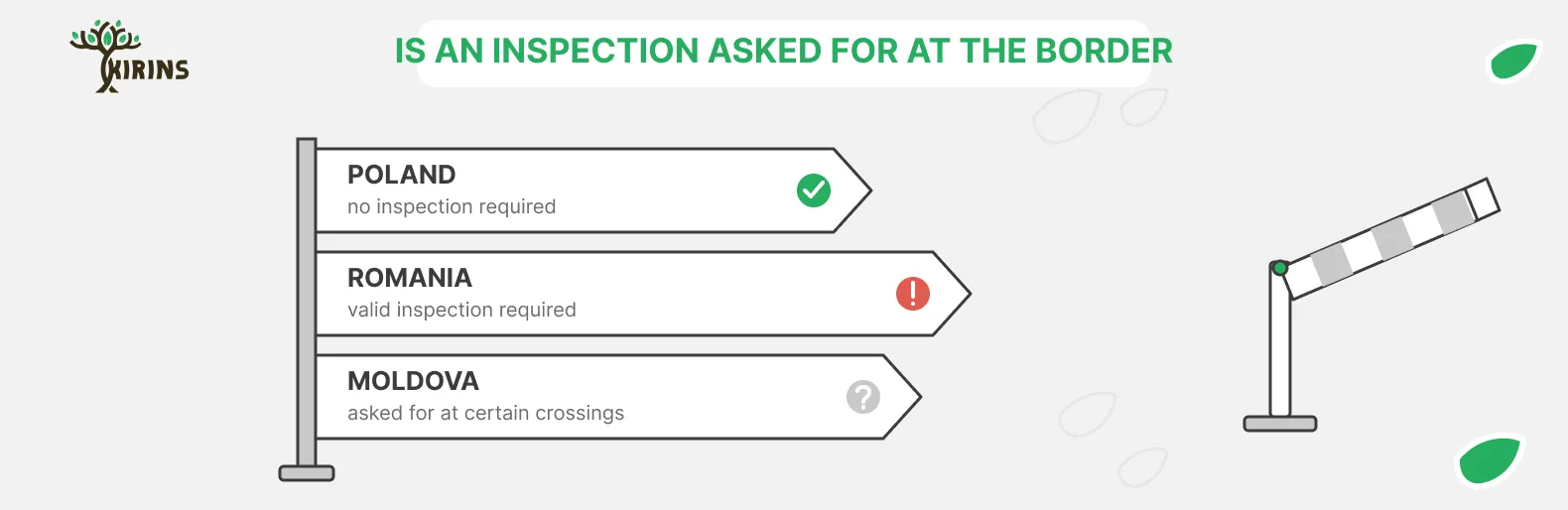
Poland never signed the 1997 agreement, so the international certificate does not exist in its legal framework, and no inspection is demanded from a Ukrainian car.
Romania is the strictest direction: the border police keep proof of periodic technical inspection on the list of entry documents, and it must be valid at the moment of crossing.
Moldova — since 16 January 2025, proof of inspection has been requested in practice at certain crossing points.
Do not confuse an inspection with low-emission zones either: the German Umweltplakette or the French Crit'Air is a sticker showing the emission class, not a certificate of technical condition.
How to get the inspection done
If you are heading for Romania or the Moldovan direction, arrange the certificate in advance. It is issued by accredited technical control operators authorised by Ukrtransbezpeka — what you need is a technical control centre, not an ordinary garage.
The procedure is straightforward. Call the station and ask directly whether they issue the international certificate and for which vehicle category — not every station works with the international form. Bring the vehicle registration document, your driving licence and passport, and if the car is not yours, a document confirming your right to drive it. Arrive in a roadworthy car: check the lights, brakes, tyres, wipers and fluid levels. The inspection takes 20 to 40 minutes.
Do not leave it until the day of departure: if a fault is found, it has to be fixed and the car brought back for a repeat check.
Which document you receive
This is where most of the confusion lies. Compulsory technical control in Ukraine produces a vehicle technical condition inspection report. It is a domestic document: it is needed for registration procedures, for admission to commercial carriage and for roadside checks, but nobody expects it at the border.
The international certificate is a separate form issued under the international agreement. So if you need a document specifically for the border, ask the station for the international certificate rather than simply "an inspection". Before you drive away, check the vehicle category, the inspection date and the validity period printed on the form.
As for validity, the certificate lasts as long as the technical control itself for your category — one year for goods vehicles over 3.5 tonnes and taxis, two years for the other commercial categories. Always take the exact date from the form.
What the price depends on
Specific figures go out of date quickly, so there is little point in quoting a "precise price list". The cost depends on the vehicle category, the city and the particular station, and on whether you are paying for the check alone or for the international form as well.
The only reliable way to find out is to call the station you have chosen and ask the price for your category. One more piece of advice: if a price is quoted without specifying the category and without mentioning the certificate form, ask what exactly you are paying for. Quite often what is sold under that name is ordinary diagnostics, which proves nothing at the border.
What else you need to drive abroad
The basic set is small: a passport, a driving licence, the vehicle registration document and, if the car is not yours, a notarised power of attorney permitting travel abroad. Add the compulsory equipment: a first aid kit, a fire extinguisher, a warning triangle and a reflective vest.
And the one thing you will certainly not be let through without is the Green Card policy. It is this, not an inspection, that is checked at every border, and it takes effect from the day after it is issued — so buying it on the morning of departure is already too late. You can calculate the price and arrange a Green Card online in a few minutes.