
10.11.2026
Your plans and your mood can be ruined in a second — for example, when a message lands on your phone saying you have a fine for a traffic violation. Such news always comes with alarming wording: pay immediately via the link, or the enforcement service will take over. In that situation it feels logical to pay at once and forget the bad dream as soon as possible. But emotions should be pushed aside, because these may well be fake traffic fines. How to recognise them and what to do about them, we explain below.
How drivers are deceived with fake fines
Let us start with the purpose of such messages. It is simple: scammers want to make you follow a link and hand over all your data yourself.
These manipulations follow fairly similar patterns, and the information usually reaches the potential victim through well-known channels.
Messengers. A message arrives on Telegram or Viber, worded to trigger strong emotions. The website you land on may closely resemble a police service, a popular bank or the Diia app.
Email. This format works on a larger scale, and it can even deliver fake payment receipts.
Notes left on the car. Such leaflets can still be found in car parks. Some of them even carry a QR code that supposedly lets you pay the fine.
Phone calls. This is rare nowadays, but it still happens — and it deceives car owners quite effectively.
Almost everyone has heard of these tricks. What matters is knowing how to tell a fake from a real fine.
Signs of a fraudulent message
To make sure scammers cannot get money out of you, it is worth knowing how to check whether a traffic fine is genuine. There are several giveaways, and spotting even one of them means you are dealing with a fake.
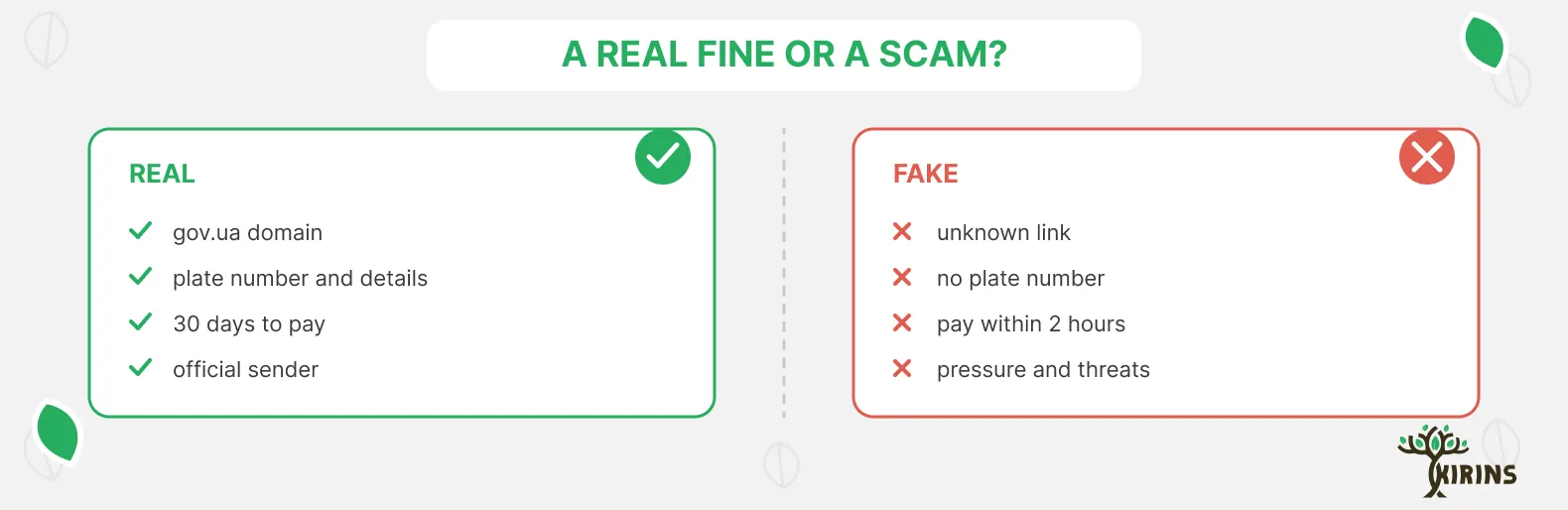
No specifics. A genuine notice always describes the violation in detail and states the vehicle registration number. Scammers usually keep this part vague.
The link. An official state resource uses a .gov.ua domain. If you see a random string of letters instead, it is definitely a scam.
An anonymous sender. A message from an ordinary phone number or an unknown contact is a fake. An official notice would come from a verified sender.
Threats and pressure. Scammers play on nerves with phrases like "final warning" or "only 2 hours left to pay". A real fine gives you 30 days, and paying within the first 10 even comes with a 50% discount.
So when a notice arrives, switch on cold reasoning and analyse what you have received.
Why following the link is dangerous
The danger of phishing aimed at drivers comes down to one thing — the link. The ultimate goal of the whole performance staged by scammers is to make you go where they need you to go.
It is dangerous because this is exactly how all the data about a driver is harvested, and that is what later helps to steal money. The websites behind such links usually look official, so many people calmly enter their details and even transfer funds.
How to check a traffic fine safely
The main rule is never to follow links, and of course never to pay a fine you have doubts about. To make sure a fine is real, check it only on official resources.
For example, this can be done through the following portals and services:
the Diia app;
the official website of the Ministry of Internal Affairs;
the mobile app or chatbot for traffic fines.
A few minutes are enough to confirm whether the fine is real and to spot a scammer in time.
What to do after receiving a suspicious message
If you are sure this is a scam rather than a real traffic fine, report it to the police. It is also worth warning older drivers among your relatives and acquaintances, since they most often fall victim to such deception.
You can also block the sender and report spam, and then simply delete the message.
Conclusion
Scammers can be found in every area of life, so it would be strange if they stayed away from traffic fines. The key is to remain one step ahead of them and to examine carefully everything that arrives on your phone or in your inbox. Insurance is another way to round out your protection. Our online insurance service KIRINS, for instance, offers some of the most favourable and secure terms, where every driver will find a suitable option.