
31.10.2026
The Law of Ukraine "On Compulsory Civil Liability Insurance of Owners of Land Vehicles" already takes into account many aspects of European legislation. However, further European integration requires full compliance with its rules and laws. At the very least, Ukrainian legislation needs to enshrine the normally based concept (the principle of a vehicle's normal basing). Under it, every vehicle registered in Ukraine must receive insurance protection and compensation in the event of a road accident, even if the party at fault has no policy. That is why it is extremely important to monitor whether drivers hold a valid insurance policy.
How many uninsured vehicles are there in Ukraine?
Cars without motor third-party liability insurance are present on Ukraine's roads. According to various estimates, they account for roughly 10–25%. It is difficult to state the exact number of uninsured vehicles.
The data in the Unified State Register is not of sufficient quality. As a result, it is impossible to determine precisely whether a registered vehicle is actually in use or simply being kept in storage.
How much do accidents involving uninsured drivers cost?
The real figures can be seen in the MTIBU statistics on regulatory payments. In July 2025, UAH 0.5 billion was paid out for damage caused by uninsured drivers. That accounts for 85% of all regulatory payments from the centralised insurance fund. The issue is compounded by the fact that, under the EU directive, compensation for damages must be provided even if the accident caused by an uninsured vehicle occurred outside the country where the car is registered.
How Is Insurance Coverage Checked in Europe?
Monitoring OSAGO compliance must be as rigorous as possible. It is precisely the cases where OSAGO insurance is missing that increase the financial burden on the insurance market.
For countries that are part of the "Green Card" insurance system, tackling uninsured drivers is a top priority. This is not only about compliance with the law, but also about protecting road accident victims and improving road safety. As EU experience shows, insurance checks work best when they are carried out in a comprehensive way.
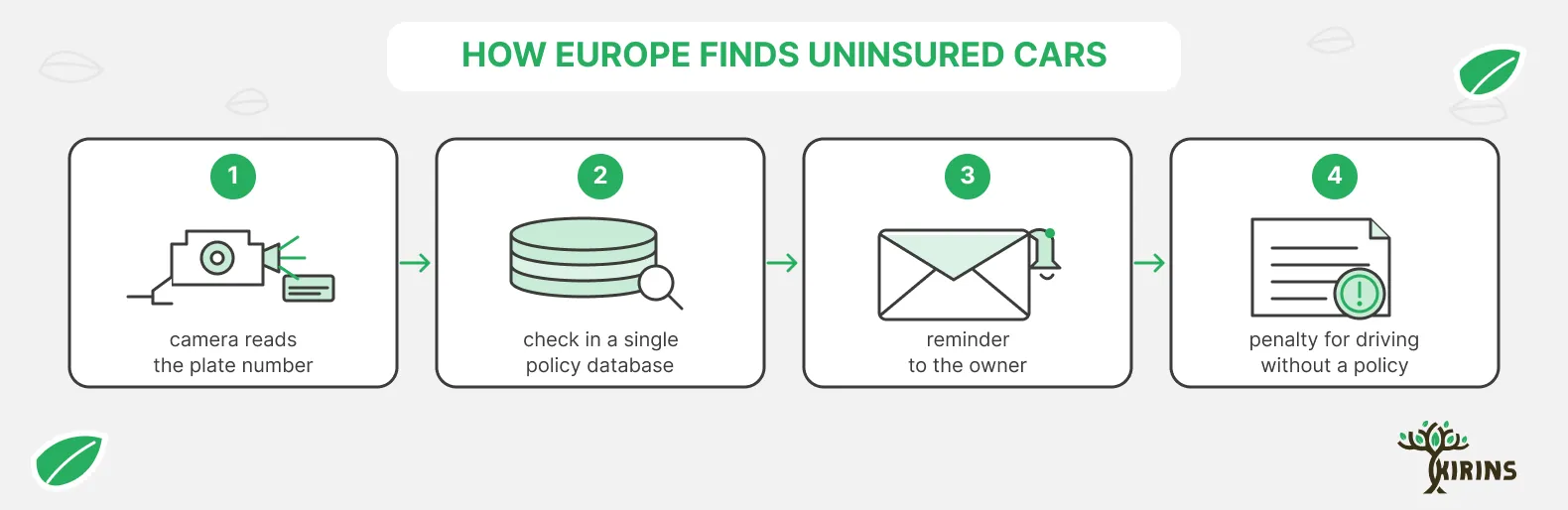
How Do Different Countries Detect Uninsured Vehicles?
Checking OSAGO insurance in Europe — or rather, checking whether it is still valid — already works quite well. There are effective mechanisms in place that make it practically impossible to drive around without a valid policy.
Insurance as a prerequisite for registration. You cannot register a vehicle, obtain licence plates or renew registration without a valid policy.
Automatic data verification and a single database. A single insurance database is linked to the state vehicle register. Importantly, the data in both registers must be constantly synchronised.
Automatic detection of uninsured vehicles. This refers to automatic number plate recognition. That is exactly how the required data can be obtained without having to stop the vehicle.
Reminders and warnings. Sometimes people simply forget to renew their insurance. In such cases, warnings and reminders are needed.
A charge for every day without a policy. There is a special payment for the days during which the car was uninsured.
Proportionate and unavoidable penalties for using a vehicle without insurance. These may include bans on using the vehicle, penalties, temporary licence suspension, confiscation of licence plates.
Recourse against an uninsured driver. The Guarantee Fund has the right of recourse against the driver who caused the accident and was driving without an insurance policy.
Working with at-risk groups and running awareness campaigns. This is done through radio, television, social media, educational programmes and similar channels.
All of these mechanisms have proven effective in EU countries.
Which system could Ukraine adopt?
Ukraine should establish a unified system of ongoing insurance monitoring. This would make it possible to integrate the MTIBU central database with the state vehicle register.
Also, drawing on Europe's experience, it is worth considering the introduction of the following:
automatic monitoring via road cameras and similar systems;
automatic detection and enforcement of liability;
reminders and notices about the need to renew a policy;
payment for the days during which the policy was not in force;
sanctions against deliberate offenders;
a subrogation mechanism against uninsured drivers at fault in road accidents;
awareness campaigns for high-risk groups and young drivers;
a transparent model for using the funds generated by the monitoring system.
Overall, Ukraine should move away from sporadic detection of violators and adopt a permanent system for identifying drivers who have no insurance.
Conclusion
A driver having a policy should first and foremost be a matter of consciously caring about their own safety and the safety of other drivers. The mechanisms already in place, and those that may yet be introduced, should not be the main reason for taking out a policy. So if you want every trip to be safe, it's worth buying compulsory OSAGO insurance on our KIRINS website.